

EV Manufacturing and Quality Control Platform
Supporting Applications in ART
EXORPHIA has built a technology platform for the manufacturing, purification, and quality control of extracellular vesicles (EVs), with a primary focus on applications in assisted reproductive technology (ART).
EVs are complex particle populations whose quality attributes can vary depending on the source cells, culture conditions, purification methods, and storage conditions. EXORPHIA designs the entire development process — from source cell selection and cell culture to EV purification and quality evaluation — to support the stable development of EV-based products and technologies for specific applications.


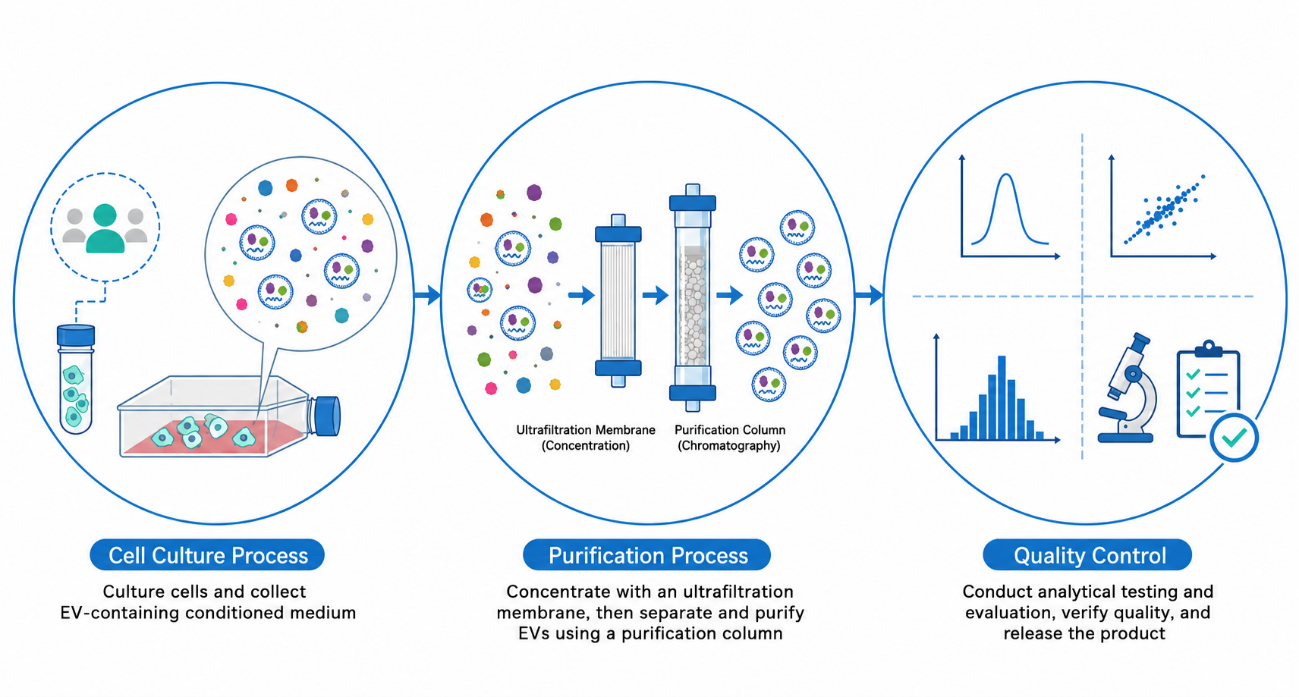
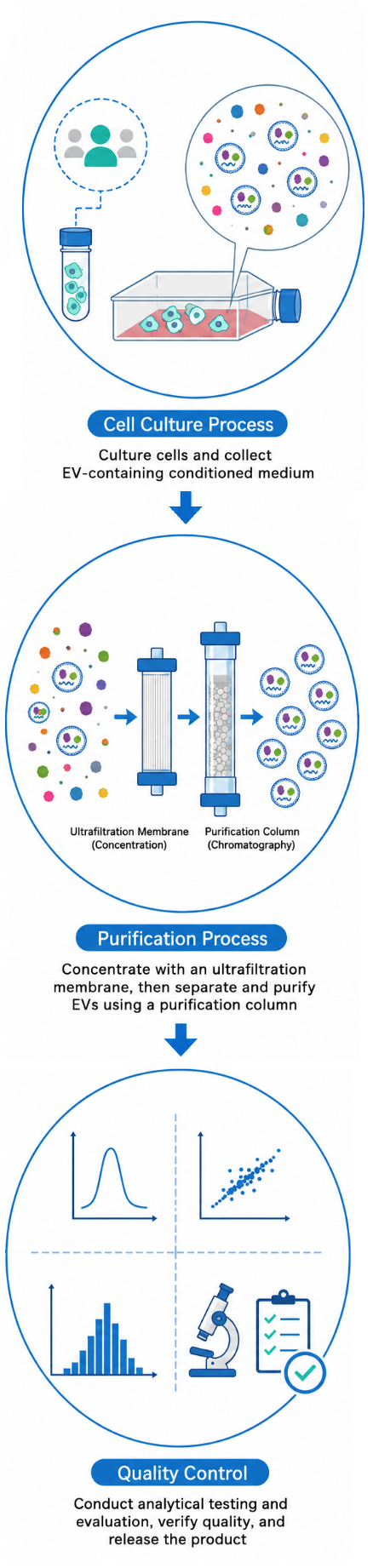
1.Upstream Process
Stable EV production from optimized cell sources
The quality of EVs is strongly influenced by the characteristics of the source cells. EXORPHIA selects appropriate donors and cell sources based on the intended application and utilizes high-quality, well-characterized cell banks as part of its EV manufacturing platform.
In the cell culture process, EXORPHIA has established optimized culture technologies designed to efficiently and consistently produce target EV populations. By controlling cell condition, culture parameters, culture duration, and medium composition, we aim to reduce lot-to-lot variability and manufacture EVs with reproducible quality attributes.
This upstream capability forms the foundation for stable EV production for next-generation embryo culture technologies in the ART field.
2.Downstream Process
High-purity separation of target EV fractions
from cell culture supernatant
Cell culture supernatant contains EVs as well as proteins, nucleic acids, medium-derived components, and cell-derived impurities. To apply EVs in research and product development, it is essential to separate and concentrate the target EV-containing fractions while appropriately controlling unwanted components.
EXORPHIA has developed purification technologies to separate EV-containing target fractions from cell culture supernatant with high purity. Our downstream process is designed to reduce impurities while maintaining the particle characteristics of EVs and meeting quality requirements for each intended application.
This downstream capability supports EV production across different development stages, from research evaluation to clinical research and future product supply.
3.Quality Control
Defining EV quality based on intended use
EVs are not single molecular entities. They are particle populations characterized by multiple quality attributes, including size distribution, particle concentration, protein content, lipid composition, RNA content, and surface markers. For EV development, it is therefore essential to define the quality attributes that are critical for each intended use and to manage lot-to-lot consistency.
EXORPHIA combines analytical methods to evaluate EV particle characteristics, purity, safety, and consistency. Based on the intended use and quality requirements of each application, we establish specifications that support reproducible EV manufacturing and development.
Our quality control framework includes evaluation items such as particle size distribution, particle concentration, protein content, EV markers, sterility, endotoxin, pH, and osmolality.
By monitoring how source cells, culture conditions, purification processes, and storage conditions affect EV quality, EXORPHIA supports the development of EV technologies with improved reproducibility and consistency.
Integrated EV Platform
EXORPHIA’s technology platform is designed as an integrated development process rather than a collection of independent manufacturing steps.
By managing source cell selection, EV production, purification, and quality analysis as a unified process, we define EV quality according to each intended application and support both stable supply and product development.
Through this integrated EV platform, EXORPHIA is advancing the practical application of EV technologies, with a primary focus on next-generation embryo culture technologies in the ART field.